
Open Color Wheel in your browser to generate Complementary, Analogous, Triadic, Split-Complementary, and Tetradic schemes across Artist RYB, Perceptual OKLCH, and Digital RGB color wheels. Everything runs locally on your device with instant sync across the shared Active Palette bar.
Pick the right wheel model for your medium
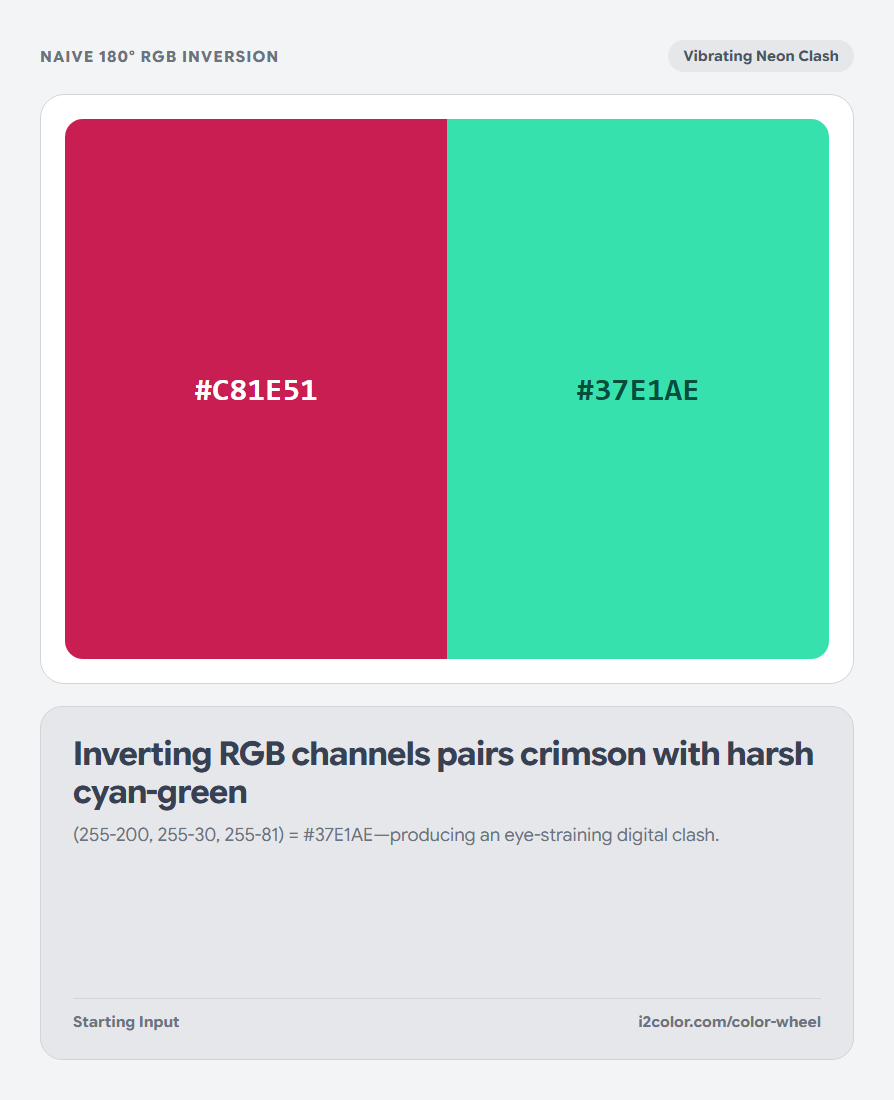
Switch between Perceptual OKLCH (best for UI, websites, and data visualization), Artist RYB (classical Red-Yellow-Blue painting wheel where red sits opposite green), and Digital RGB/HSL.
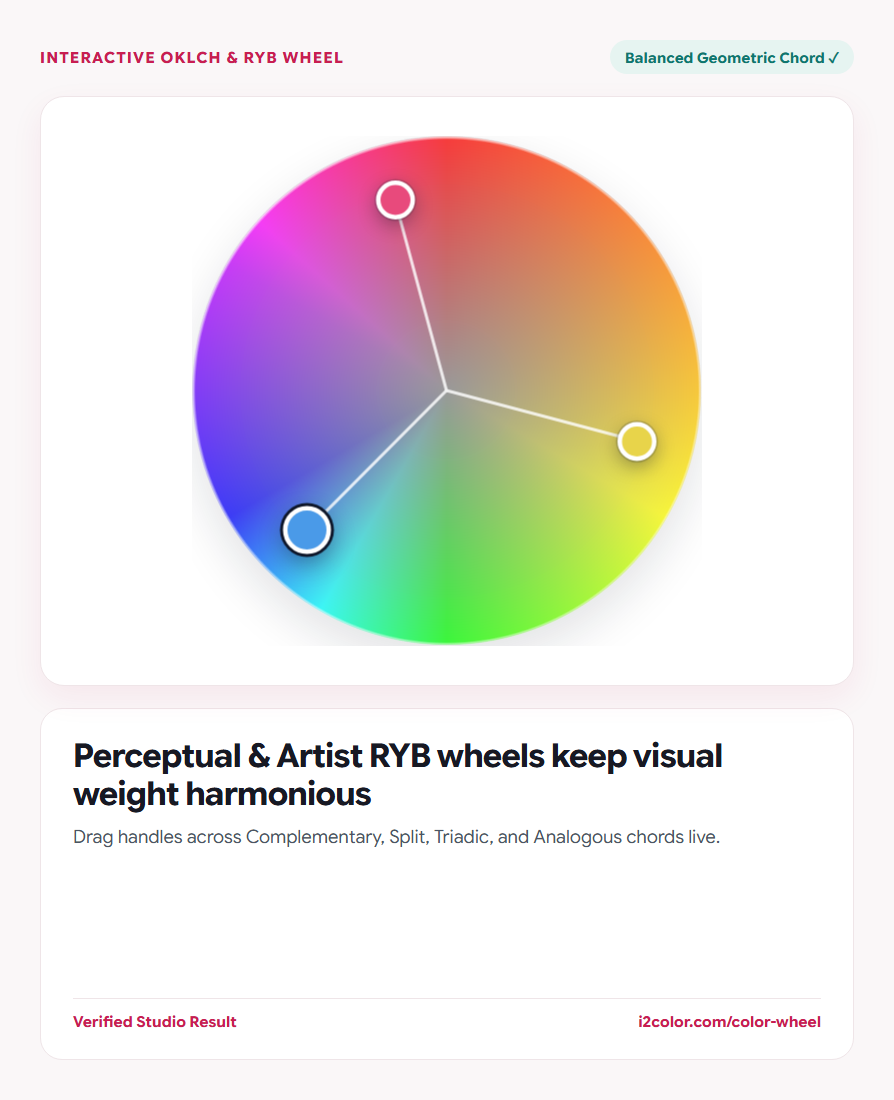
Drag the primary anchor ring anywhere on the wheel—or enter an exact #HEX code—to rotate the entire geometric chord in real time.
Quick comparison: Toggle between RYB and OKLCH on the same base HEX to see how classical fine-art complements warm up compared to digital complements.
Match the harmony rule to your layout complexity
Select one of the classical harmony geometries and watch the linked handles snap to exact angular offsets around the wheel.
Pull handles inward toward the center to soften saturation for background surfaces, or outward toward the rim for crisp call-to-action accents.
Complementary & Split
High focal energy—use Split-Complementary (±150°) when pure 180° opposites feel too intense.
Analogous
Calm, cohesive neighboring hues ideal for editorial gradients, nature brands, and illustrations.
Triadic & Tetradic
Evenly spaced 3- and 4-hue chords suited to multi-category badges, icons, and playful brands.
Promote your wheel chord into a full UI palette
Click Apply to Palette to push the wheel swatches into your Active Palette bar, then open Palette Visualizer or copy the CSS variables directly.
:root {
  --wheel-anchor:  #C81E51; /* 12°  OKLCH Anchor  */
  --wheel-split-a: #1F7A6E; /* 182° Cool Teal     */
  --wheel-split-b: #D97706; /* 72°  Warm Amber    */
}Common questions
Why is purple opposite yellow on an RYB wheel but blue is opposite yellow in RGB?
RYB spaces red, yellow, and blue at 120° based on subtractive paint mixing, whereas RGB spaces red, green, and blue lights at 120°.
Which harmony rule is easiest to balance on a landing page?
Split-Complementary and Analogous are the most forgiving—keep one hue dominant and use the remaining chord colors sparingly at 10% weight.
Can I copy individual HEX codes directly from the wheel swatches?
Yes. Click any harmony swatch card beside the wheel to copy its uppercase #HEX code immediately.
Try Color Wheel
Compare traditional artist pigment opposites against modern perceptual UI harmonies.